To provide deep support for the national "Belt and Road" Initiative and the Lancang-Mekong Cooperation strategy, and to advance coordinated progress in the conservation, digital utilization, and breeding innovation of tea tree germplasm resources between China and Laos, the plaque-unveiling ceremony for the Yunnan Provincial International Joint Laboratory for the Digital Conservation and Germplasm Innovation of China–Laos Tea Tree Resources was held on May 9, 2026. The ceremony was hosted by the College of Tea and Coffee at Pu'er University and brought together tea-science experts and scholars from both China and Laos, along with representatives from the relevant government authorities.
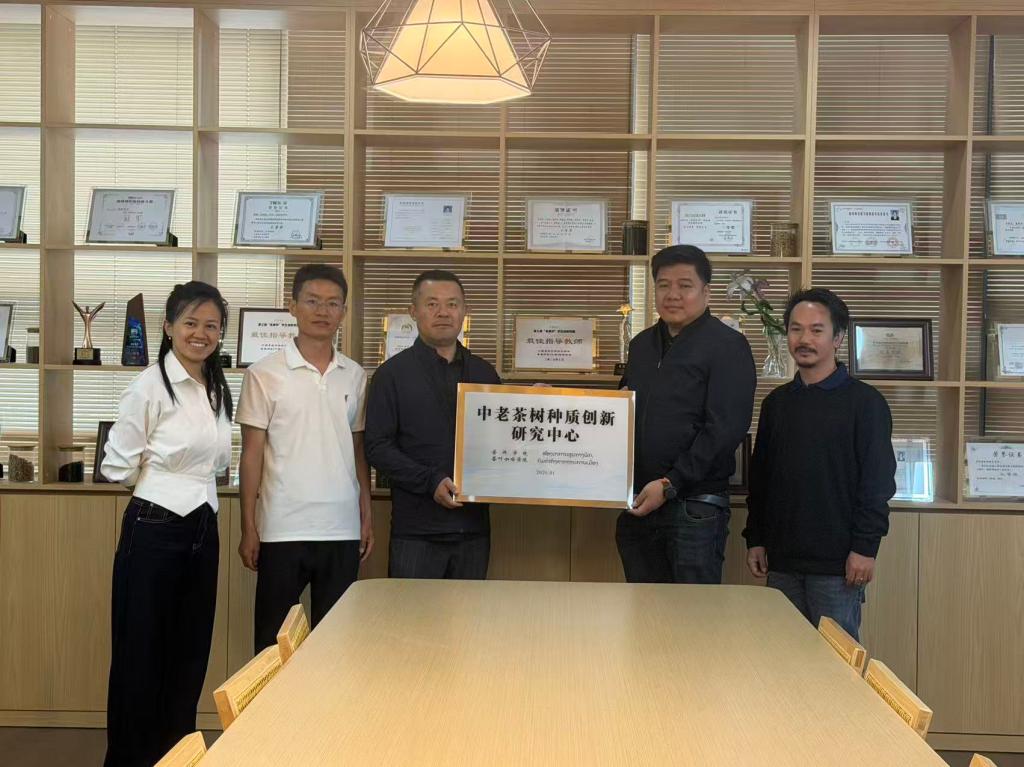
Yunnan is the native home and a core production region of the world's tea trees. The tea-growing areas of northern Laos share the same mountains, rivers, and tea heritage as Pu'er in Yunnan, and the two regions are endowed with distinctive, highly complementary tea tree resources. Since the laboratory was approved in June 2023 and established under its plaque that same year, it has consistently focused on four core missions: the digital conservation of tea tree germplasm resources, the mining of superior genes, the breeding of new varieties, and the joint cultivation of international talent. This formal unveiling not only represents strong recognition of the laboratory's achievements to date, but also marks a new starting point for deepening China–Laos cooperation in tea science and technology and for promoting the high-quality development of the tea industry. The laboratory is an important part of Yunnan's international joint innovation platform and aligns with the province's strategic positioning as a hub radiating toward South and Southeast Asia. It is hoped that the laboratory will seize this opportunity to build on its base in Pu'er while connecting with Laos, integrating the full chain of "resource conservation—digital empowerment—germplasm innovation—industrial transformation," overcoming key technical challenges such as the precise identification of tea tree germplasm resources and the breeding of superior varieties, and establishing a benchmark platform for China–Laos agricultural science and technology cooperation—thereby providing solid technological support for improving the quality and efficiency of Yunnan's tea industry, advancing rural revitalization, and fostering people-to-people bonds between China and Laos.
The representative from the Lao side, from the Lao Ministry of Agriculture and Forestry, extended warm congratulations on the laboratory's unveiling. He noted that the tea industry in northern Laos is a pillar of the local agricultural economy, yet it faces challenges such as lagging resource conservation, aging varieties, and weak technical capacity. The establishment of the laboratory builds a vital bridge for China–Laos cooperation in tea science and technology. Going forward, it will promote the in-garden preservation of Lao tea tree germplasm resources, support joint breeding trials, and enable the sharing of research findings and technical expertise—helping to transform and upgrade Laos's tea industry and achieve mutually beneficial, shared development. The meeting clearly identified areas for in-depth cooperation, including resource surveys, gene sequencing, variety breeding, mutual exchange of personnel, and technical training. Professor Zhao Feng, the laboratory's director on the Chinese side, explained that the laboratory will next focus on building three core platforms: a digital database of China–Laos tea tree resources, a germplasm preservation garden, and a molecular breeding laboratory. Over the next three to five years, it aims to collect and preserve superior China–Laos tea tree resources, breed three to five high-quality, stress-resistant new tea tree varieties with independent intellectual property rights, and train a cohort of tea-science professionals who combine international vision with hands-on skills—positioning the laboratory as a domestically leading and internationally renowned center for the conservation and innovation of tea tree germplasm resources.
This unveiling ceremony marks the entry of China–Laos cooperation in tea tree germplasm conservation and innovation into a new, more standardized and enduring phase. In the future, the laboratory will continue to use tea as a medium and technology as a bridge, deepening China–Laos agricultural science and technology cooperation, empowering the high-quality development of the tea industry, and contributing even greater strength to advancing agricultural modernization across the Lancang-Mekong region and deepening the comprehensive strategic partnership between China and Laos.